

Several years ago, while living in China and studying Mandarin each day, I came across the word wēijī (危机), meaning “crisis.”

The word is often misinterpreted in Western business culture as meaning “danger plus opportunity,” but its deeper meaning is more subtle than that.
The first character, wēi (危), suggests danger, instability, or something precarious.
The second character, ji (机), refers to a turning point, a hinge moment, a critical juncture where events may suddenly shift direction.
Together, 危机 describes a moment where danger and transformation become inseparable. A situation unstable enough that small actions may decisively alter the future.
- Not catastrophe.
- Not triumph.
- A turning point.
On Tuesday, May 18, Google introduced exactly that kind of turning point for millions of websites built around the fragile economics of search traffic.
Explore the Shift:
- Search Has Become an AI Conversation
- The New Goal: Become a Trusted Source
- What AI Search Appears to Value
- The Rise of Entity-Based Search and AEO
- Structure Is No Longer Just Design. It Is Meaning
- What Website Owners Should Do Right Now
- FAQ: SEO, AI Search, and the Future of Websites
- The Human Web May Be Returning
For more than two decades, the internet has operated on a relatively simple bargain.
You create a website. You write content. You optimize for keywords. Google rewards you with traffic. That era just ended.
Camille Cohen/AFP via Getty Images
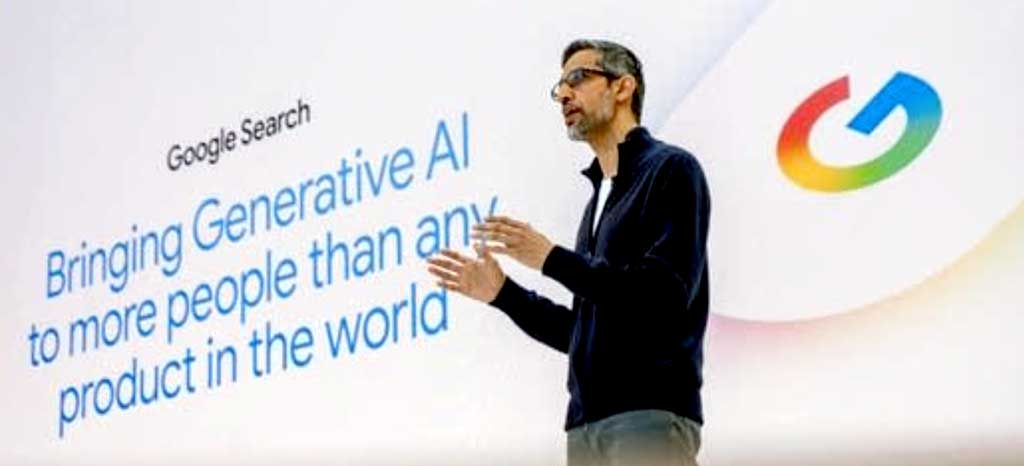
At Google’s recent I/O conference, they announced the biggest overhaul to its search engine in 25 years.
Instead of serving users a familiar page of “ten blue links,” Google has shifted to AI-generated answers, conversational interaction, and automated “information agents” that perform tasks behind the scenes (links remain, but they are now deprecated). In plain English this means people will no longer search the web the way they used to.
And for website owners, publishers, writers, marketers, and creators, the implications are enormous.
Search has become an AI conversation.
Since the early 2000s, Google search model acted like this:
- Users typed keywords into a search box
- Google returned a ranked list of links
- Users clicked through to individual websites
- Meanwhile, website owners fought to appear “above the fold” on the first page of results
Google’s new AI-driven model increasingly behaves more like this:
- User asks a full conversational question: “What’s the best way to publish an email newsletter without it getting too long?”
- AI summarizes information instantly.
- Google will now typically engage the inquiring user by opening a conversation without sending them anywhere. Game over.
Google’s Gemini AI now acts less like a search engine and more like a research assistant.
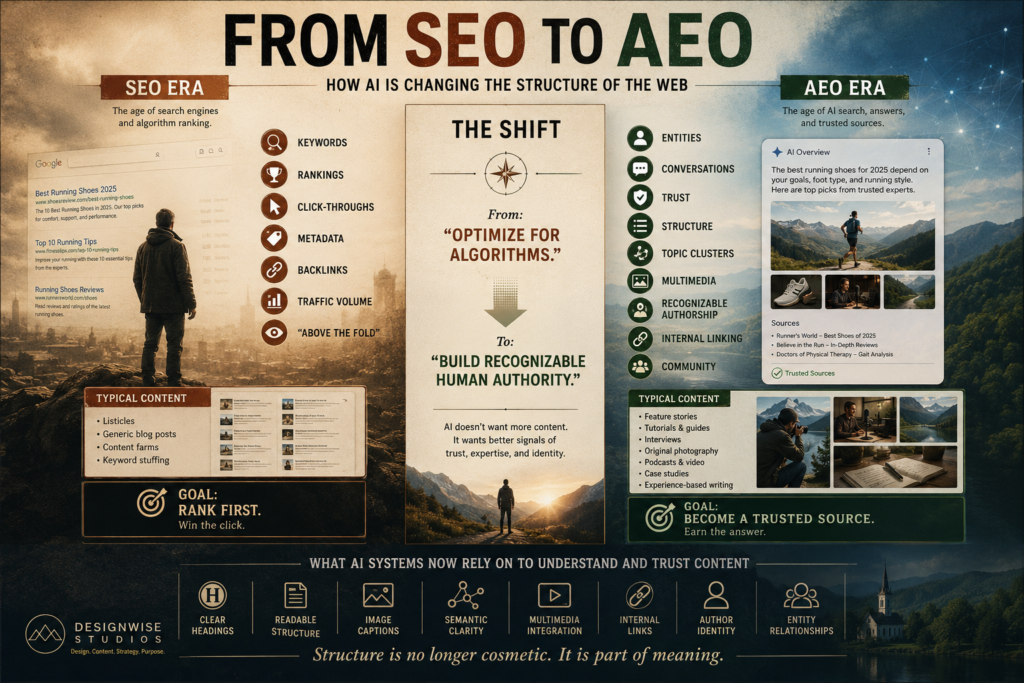
But this transition also reveals something important: AI still needs trusted sources. And that changes the entire nature of SEO regarding: keyword density, backlinks, metadata, search phrases, content farms, listicles, and the ubiquitous “Top 10” articles.
While the web slowly rotted with repetitive content written primarily for algorithms instead of humans, AI appeared to devastate much of that model. The search for generic information has become automated.
Meanwhile, authentic human expertise has become more valuable.
The New Goal: Become a Trusted Source
The future of visibility online will no longer depend on: “How do I rank #1 for a keyword?” Instead, the new goal becomes: “Will AI systems trust my website enough to reference it?” That is a completely different strategy.
What AI Search Appears to Value
Our early research suggests AI-driven search systems reward:
- Original Experience – Firsthand stories and real-world expertise matter more than recycled summaries.
- Recognizable Identity – Creators, authors, organizations, and businesses with clear public identities appear more trustworthy.
- Structured Information – Clear headers, organized formatting, and readable layouts that are designed to help AI understand your content.
- Cross-Platform Presence – Websites that are connected to a YouTube channel, their own podcasts, newsletters, LinkedIn and Facebook pages, and other social media will appear stronger.
- Human Authority – Having an authentic voice will increasingly beat generic AI-generated filler.
In many ways, the web is becoming more human again.
For independent creators and small agencies like ours, DesignWise Studios sees this shift as both dangerous and full of opportunity. Mass-produced SEO content has become less valuable. But local expertise, storytelling, and visible human identity are now more important than ever. That means:
- feature stories matter
- documentary-style writing matters
- original photography matters
- video matters
- interviews matter
- visible authorship matters
A generic article titled: “10 Best Website Tips” will lose out to: “How We Rescued a Financial Website from Spam, Security Risks, and Digital Decay” One is generic while the other contains lived experience.
Personalized strategic guidance for creators, publishers, organizations,
and businesses adapting to AI-driven search.
Google increasingly organizes information around entities rather than simple keywords.
An entity can be:
- a person
- a business
- an organization
- a location
- a public identity
For independent creators, publishers, and small businesses, this changes the nature of online visibility entirely. In our own case, it means rethinking how the following identities must connect across the web:
These are no longer isolated websites or projects. Together, they form a connected digital ecosystem that search engines increasingly interpret not simply as content, but as evidence of recognizable human expertise and authority.
Structure Is No Longer Just Design. It Is Meaning.
In the old SEO world, layout was often treated as a readability issue. Headers, short paragraphs, bullet points, captions, and internal links helped human visitors scan a page. That is still true. But in the age of AEO, structure does something else too. It helps machines understand what the page is actually about.
A well-structured post gives AI systems clearer signals:
- what the main topic is
- which questions the article answers
- which sections matter most
- how one idea connects to another
- what can be summarized, quoted, or referenced
This means the layout of a post is no longer cosmetic. It is part of the content itself. A strong article now needs:
- a clear title
- descriptive H2 and H3 headings
- short paragraphs
- meaningful bullet lists
- image captions
- internal links to related articles
- a short Q&A or FAQ section
- a concise summary near the end
This is not about dumbing down the writing. It is about making the intelligence of the article visible to both human readers and AI systems. A dense wall of text may still contain insight, but it is harder for readers to navigate and harder for AI to interpret. A well-organized article gives the content a stronger chance of being understood, summarized, cited, and trusted.
In other words, formatting has become part of authority.
What Website Owners Should Do Right Now
A practical guide for creators, publishers, organizations,
and small businesses adapting to AI-driven search.
For website owners, creators, publishers, and independent businesses, the shift from SEO to AI-driven search is not simply technical. It requires rethinking how authority, structure, and identity are presented online.
Practical priorities now include:
- publishing original experience-based content
- using strong H2 and H3 headings
- breaking complex ideas into readable sections
- adding captions to original images
- strengthening internal links between related articles
- building topic clusters instead of isolated posts
- embedding video, photography, podcasts, and multimedia
- maintaining recognizable authorship and branding
- connecting websites to social, newsletter, and community platforms
- prioritizing clarity and trust over keyword repetition
The future web may reward recognizable expertise more than sheer content volume. In many ways, websites are becoming less like digital brochures and more like living knowledge ecosystems.
FAQ: SEO, AI Search, and the Future of Websites
Not entirely. Technical SEO still matters, including performance, mobile responsiveness, metadata, accessibility, and internal linking. But AI-driven search increasingly prioritizes authority, structure, and trusted content over keyword manipulation alone.
AEO stands for Answer Engine Optimization. Instead of optimizing solely for search rankings, AEO focuses on helping AI systems understand, summarize, and trust your content.
In many cases, yes. AI systems increasingly summarize information directly inside search experiences. This may reduce casual search traffic while increasing the importance of recognizable brands, newsletters, communities, and direct audience relationships.
Original reporting, feature stories, tutorials, interviews, case studies, podcasts, video, photography, and experience-based writing may become increasingly valuable because they demonstrate human expertise and authenticity.
AI systems rely heavily on structure to interpret content. Clear headings, concise sections, bullet points, captions, and internal links help both readers and machines understand what a page is actually about.
An entity can be a person, business, organization, place, or recognizable identity. Google increasingly evaluates how these entities connect across the web as signals of authority and trust.
The Human Web May Be Returning
Personalized strategic guidance for creators, publishers, organizations,
and businesses adapting to AI-driven search.
For years, much of the internet drifted toward automation, repetition, manipulation, and content designed primarily to satisfy algorithms. Ironically, artificial intelligence may now be pushing the web back toward something more human. Not because machines suddenly value humanity. But because authentic experience, recognizable identity, trust, structure, storytelling, and lived expertise are increasingly difficult to fake convincingly at scale.
The future of search may belong less to anonymous websites chasing traffic and more to creators, organizations, and communities capable of building genuine authority over time. For independent publishers and small creative studios, that shift is both unsettling and full of possibility. Wēijī 危机 a turning point.

Stephen Kastner is the founder of DesignWise Studios and Green Mountain Writers. His work spans storytelling, digital publishing, documentary filmmaking, photography, AI visibility strategy, and human-centered marketing. Beginning as a newspaper photojournalist in the 1980s and later building websites and online learning systems during the early internet era, he writes frequently about authenticity, media, communication, publishing, and the evolving relationship between technology and human identity.